E-bike Incentives in Switzerland
E-bike subsidies in Switzerland
Anyone considering buying an e-bike or cargo bike will soon ask themselves an obvious question: Are there subsidies available for this in Switzerland, and if so, where?
The answer is: Yes, they exist.
E-bike subsidies in Switzerland: How are they structured?
Unlike in Germany (BAFA subsidy), there is no uniform national subsidy program for e-bikes in Switzerland. Support is provided at three levels:
Cantonal
Some cantons offer their own grants, often through the cantonal energy or mobility office.
Municipal
Many municipalities have their own programs for purchasing e-bikes and cargo bikes.
Funded by a foundation
Programs such as that of the Albert Koechlin Foundation (AKS) are specifically aimed at businesses and supplement public funding with their own resources.
Cargo Bike Incentives in Switzerland
The best-known and most thoroughly documented subsidy program in Switzerland specifically for cargo bikes is the partnership between the Albert Koechlin Foundation (AKS) and the City of Lucerne.
What is eligible for funding?
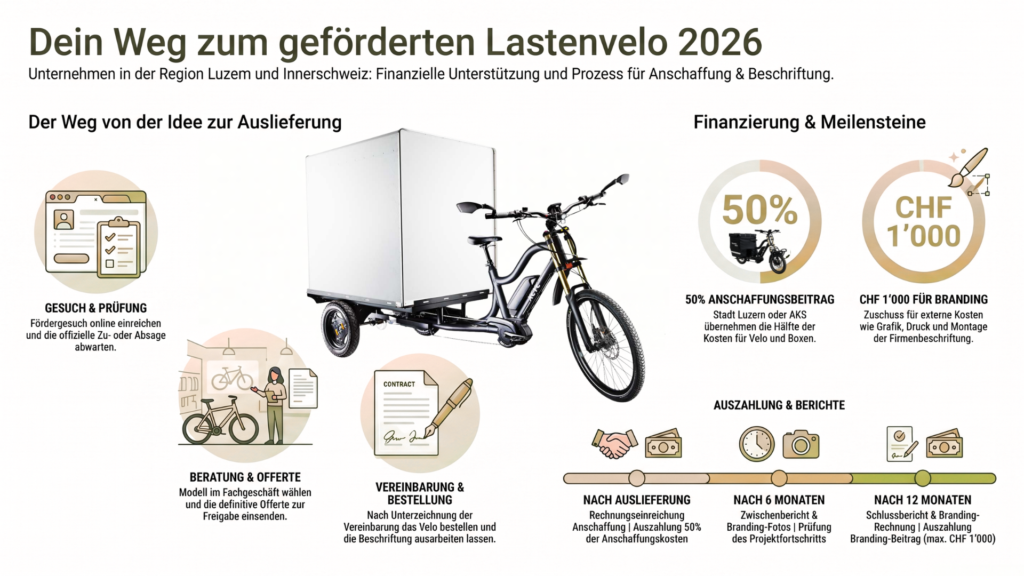
AKS and the City of Lucerne will cover 50 percent of the purchase cost of the cargo bike. In addition, AKS will contribute up to CHF 1,000 toward the vehicle’s company branding. The package thus covers both the purchase and the professional branding of the vehicle as a company vehicle.
Who is eligible?
The program is open to businesses, companies, and organizations that have their headquarters or a branch office in the city of Lucerne, the surrounding area, or the greater Central Switzerland region. For businesses located outside the city of Lucerne, funding is provided directly through AKS. Public institutions are not eligible.
In addition to the address, proof is also required that there is a specific need for the vehicle and that it is actually used in day-to-day operations.
Since the program launched in 2022, over 80 companies and organizations have already received support. The program has been extended through 2028, with AKS providing a total of CHF 270,000.
How does the cargo bike subsidy application process work?
1.
The application is submitted entirely online using the form at cleverunterwegs.ch. It includes information on your motivation, intended use, vehicle preference, operational details, contact person, and a confirmation of your business address.
2.
After submitting the application, AKS or the City of Lucerne will contact you. The business will work with a local bicycle shop to select the right model, including test rides and consultation. An agreement will then be signed, and the bicycle will be ordered and delivered.
3.
Important: The business must initially cover the full cost of the purchase and signage itself. The subsidy will be reimbursed only after the relevant receipts have been submitted—the 50% contribution toward the purchase following the first business report, and the final payment for the signage after six to twelve months.
What types of cargo bikes are eligible for funding?
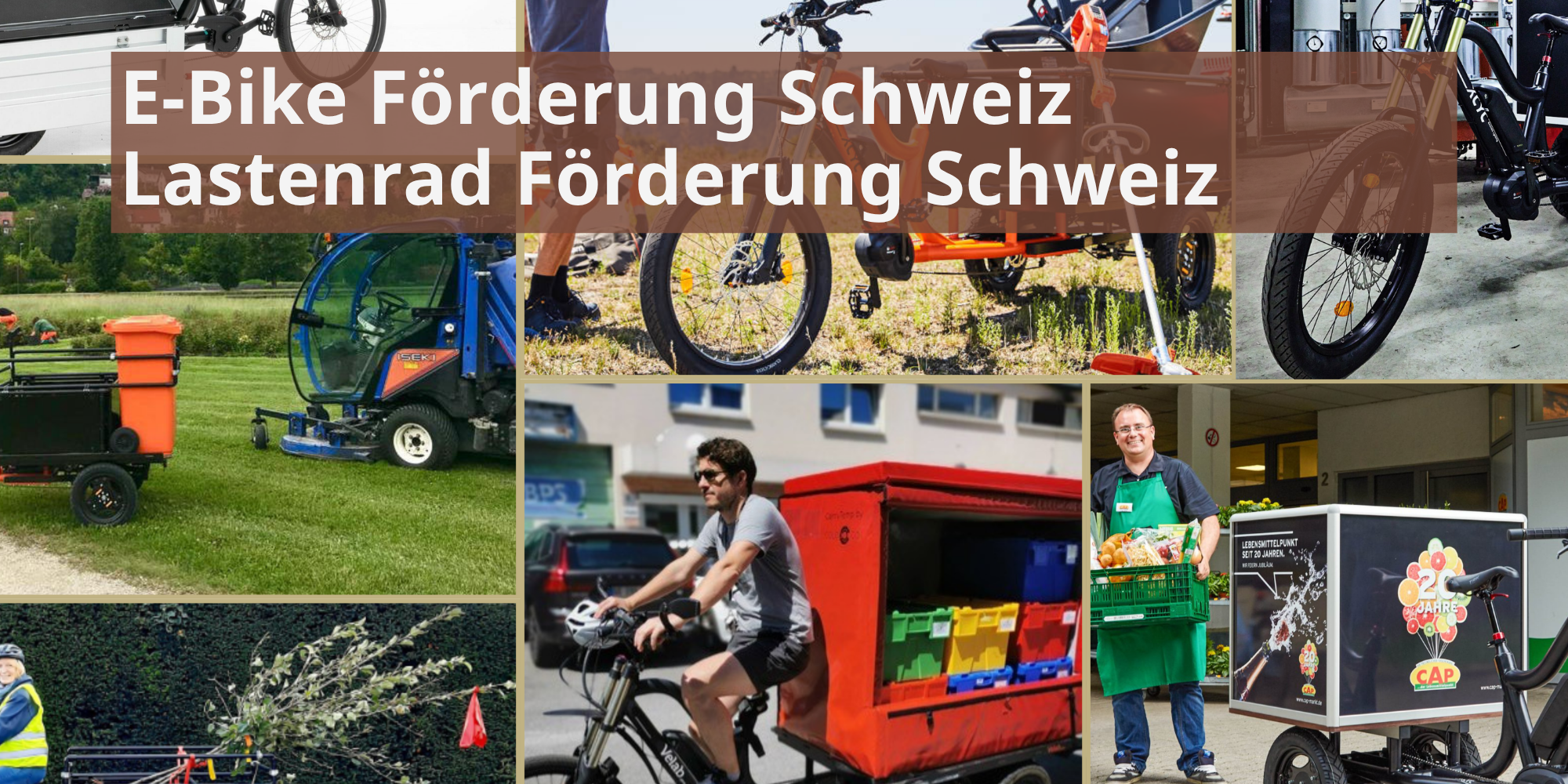
The program is technology-neutral and includes various types of models, including tricycles such as XCYC cargo e-bikes, as well as longtails, longjohns, and micro-cargo bikes, with or without trailers.
The XCYC Cargo e-bikes available in the YouMo Shop are a great place to start: sturdy, practical models that are ideal for exactly these types of use, from city commuting to local delivery logistics.
FAQ: Cargo E-Bike Incentives in Switzerland for Businesses
You can find the right cargo e-bikes for your business in the YouMo Shop
Are there any e-bike subsidies available for businesses in Switzerland?
The program is aimed at businesses with headquarters or branches in the city of Lucerne, the surrounding area, or the entire Central Switzerland region. Businesses located outside these areas receive support directly from AKS.
Is the e-bike subsidy paid out before or after the purchase?
Always after the purchase. The purchase and labeling are initially fully pre-financed by the company. The subsidy payments are reimbursed only after the receipts have been submitted.
What documents do I need to apply for the AKS program?
Information regarding motivation, intended use, vehicle preference, operation, and contact person, as well as confirmation of the company’s registered office. The form is available at cleverunterwegs.ch.
Are only cargo bikes eligible for subsidies, or are regular e-bikes as well?
The AKS/City of Lucerne program is specifically designed for cargo bikes used by businesses. For other types of e-bikes—such as those for employees—there are separate programs in individual municipalities and cantons; it is recommended to inquire directly with local authorities.
Gibt es eine Förderobergrenze für die Anschaffung?
The program covers 50 percent of the purchase cost as well as up to CHF 1,000 for lettering. The available sources do not specify an upper limit for the purchase cost itself.
What if my canton isn't on the list of eligible areas?
Contact the local municipality or the cantonal Office of Energy and Mobility directly; many programs are run at the municipal level and change regularly.
E-bike Subsidies in Switzerland
In French-speaking Switzerland, funding opportunities are more widely distributed at the municipal and cantonal levels. There are also opportunities for e-bike funding there, both for individuals and for businesses.
Canton of Geneva
| Cantonal subsidy (Canton of Geneva) | 10% of the purchase price; max. CHF 500 | Info |
| Aire-la-Ville | CHF 350 per e-bike | Information |
| Anières | 50% of the purchase price; max. CHF 250 | Info |
| Avully | 50% of the purchase price; max. CHF 200 | Info |
| Avusy | CHF 200 per e-bike | Information |
| Bardonnex | 10% of the purchase price; max. 500 CHF | Info |
| Bellevue | 10% of the purchase price; max. 500 CHF | Info |
| Céligny | CHF 250.- per E-Bike | Information |
| Chêne-Bougeries | CHF 250.- per E-Bike | Information |
| Chêne-Bourg | CHF 200.- per E-Bike | Information |
| Choulex | CHF 250.- per E-Bike | Information |
| Collex-Bossy: | of the cantonal subsidy | Information |
| Collonge-Bellerive | CHF 500.- per E-Bike | Information |
| Cologny | CHF 500.- per E-Bike | Information |
| Genthod | CHF 500.- per E-Bike | Information |
| Lancy | 10% of the purchase price; max. CHF 500 | Info |
| Meyrin | CHF 500.- per E-Bike | Information |
| Plan-les-Ouates | Max. CHF 250 (50% of the cantonal subsidy) | Info |
| Presinge | CHF 500.- per E-Bike | Information |
| Satigny | CHF 250.- per E-Bike | Information |
| Thônex | 50% of the purchase price; max. CHF 250 | Info |
| Vandoeuvres | CHF 250.- per E-Bike | Information |
| Vernier | CHF 200.- per E-Bike | Information |
Canton of Neuchâtel
| Neuchâtel (city) | 10% of the purchase price; max. CHF 700 | Info |
Canton of Vaud
| Montricher | 20% of the purchase price; max. CHF 400 | Info |
| Mont-sur-Rolle | CHF 300 per e-bike | Information |
| Morges | 20% of the purchase price; max. CHF 800 | Info |
| Nyon | 10% of the purchase price; max. CHF 700 | Info |
| Ollon | 10% of the purchase price; max. CHF 300 | Info |
| Orbe | CHF 500 via cargo bike | Information |
| Ormont-Dessus | 20% of the purchase price; max. CHF 300 | Info |
| Paudex | 20% of the purchase price; max. CHF 600 | Info |
| Payerne | CHF 300.- per E-Bike | Information |
| Préverenges | CHF 150.- per E-Bike | Information |
| Prilly | 20% of the purchase price; max. CHF 1,000 | Info |
| Pully | 10% of the purchase price; max. CHF 200 | Info |
| Renens | 20% of the purchase price; max. CHF 400 | Info |
| Rolle | CHF 300.- per E-Bike | Information |
| Romanel-sur-Lausanne | CHF 300.- per E-Bike | Information |
| Sainte-Croix | CHF 250.- per E-Bike | Information |
| Saint-Sulpice | 20% of the purchase price; max. CHF 400 | Info |
| Sullens | 10% of the purchase price; max. CHF 300 | Info |
| Tannay | CHF 300.- per E-Bike | Information |
| Tolochenaz | 25% of the purchase price; max. CHF 300 | Info |
| Vaux-sur-Morges | 20% of the purchase price; max. CHF 1,000 | Info |
| Vevey | 10% of the purchase price; max. CHF 300 | Info |
| Villars-Sainte-Croix | 15% of the purchase price; max. CHF 300 | Info |
| Villeneuve | CHF 300.- per E-Bike | Information |
| Vufflens-le-Château | 20% of the purchase price; max. CHF 400 | Info |
| Yens | CHF 250.- per E-Bike | Information |
| Yverdon-les-Bains | 30% of the purchase price; max. CHF 1,000 | Info |
| Yvorne | 20% of the purchase price; max. CHF 400 | Info |
How to Make the Most of the Grant
Payment is made only after the purchase, based on the submitted invoices. The business is responsible for covering the initial costs. Therefore, choosing the right vehicle is the first practical step, even before the application is submitted.
Determine needs
What distances, what loads, who is driving?
Check funding programs
Is there a program at the site, and is the business eligible for funding?
Select a model
Schedule a test drive
Submit your application on time
Funds and deadlines are limited
Keep all receipts
Purchase and labeling invoices are required for billing